Showing posts with label Others. Show all posts

India is gearing up for PTM2011 in New Delhi


The final day of the three-day PATA Travel Mart 2010 (PTM 2010), September 14-17, saw international buyers, sellers and media delegates gather at the dinner reception hosted by the Ministry of Tourism, Government of India. Rajen Habib Khwaja, Secretary of Tourism, Ministry of Tourism, Government of India, welcomed delegates to PATA Travel Mart 2011, New Delhi, India.

Said Hiran Cooray, PATA Chairman: “The PATA Travel Mart 2011 in New Delhi, India is one of the most exciting events and activities planned to roll out next year. We have a very special relationship with India, which is a rapidly emerging market, and we are delighted they are hosts for the PTM2011.”

Said Arjun Sharma, managing director, Le Passage to India: "The travel fraternity in India is excited that PATA has chosen New Delhi as the venue for PTM2011. With the explosive outbound numbers emanating from our country it is not uncommon for increased and newer destinations to woo the Indian traveller. The Mart returning to India after a gap of only three years is appropriately positioned and bears testimony to the growth of Indian tourism. The capital city is presently gearing up to host the Commonwealth Games next month. With the increased capacities and greatly modernised tourism infrastructure, we wish to assure you that New Delhi will be a bigger, better and more satisfying venue for the best trade show of the year. We look forward to welcoming all delegates to ‘Incredible India.’”

Said Ashok Kapur, CEO, Khiri DMC: “India is a fantastic choice as it is a rapidly emerging destination and market. With its incredible diversity and population, India deserves much more business, both as an inbound and outbound entity. As a travel specialist focussing on Thailand and Indochina, Khiri Travel will continue to invest strongly in the Indian outbound market. We see huge potential there for sectors such as leisure, MICE, honeymoon and top-end incentive trips. India's rapidly increasing urban middle class as also more direct flights from the primary and secondary cities to Southeast Asia are both very encouraging trends.”

Said Nicoline Dolman, director of sales and marketing, Bali Dynasty Resort: “We will definitely participate in PTM in India. The Indian family market has a huge potential for the travel-and-tourism of Bali. Balinese cultures and religion are the main attractions for the Indian market.”

Said Ashwani Gupta, managing director, Dove Travels, India, and a first-time attendant at PTM: “I am very excited about my attendance. PATA Travel Mart is world famous for its travel trade networking opportunities and also for its high level of organisation. It is a truly international event, very well organised, with meetings with your existing business partners spread into perfect time slots, and meetings with new exhibitors made accessible so as to improve our way of working and business.”

ERA airlines and airports demand volcanic ash damages from European governments


Airline Presidents
and Airport Directors who met yesterday in Barcelona at the Annual General Assembly of the European Regions Airline Association (ERA), expressed outrage at the failure of Europe’s politicians and regulators to act to provide financial compensation to the industry following the eruption of Mount Eyjafjallajoekull which caused widespread closure of airspace and cancellation of flights. Outraged at the lack of action by national governments across Europe to compensate airlines for the financial damages they incurred, for events totally beyond their control, ERA Airline and Airport Directors agreed to a course of action to recover financial damages through legal action.
Speaking at the General Assembly, Antonis Simigdalas, ERA President and Mike Ambrose ERA director general, said: “Europe’s politicians have sat on their hands for far too long on this issue, airlines have now lost patience and have been forced to seek alternative legal solutions to recover the additional costs they incurred.
“The events in April showed that air transport is an essential element of our society and it is now time for governments to recognise the value that air transport brings to the economy and the European communities it serves.”
In concluding a course of action, the Airline Presidents and Airport Directors instructed the ERA Directorate to explore any opportunity for instigating a class action to recover damages.

Dreams of Olympic tourism could be a nightmare


Research and analysis released on 20th September 2010 by the European Tour Operators Association (ETOA) shows that the vast numbers of foreign visitors anticipated to arrive at previous Olympics did not materialise. No host city has predicted demand for an Olympics correctly. They have invariably over-estimated the number of foreign visitors and the duration of their stay. Sydney anticipated 132,000 visitors; it received 97,000 for the Games period. Athens hoped for 105,000 per night; it received fewer than 14,000. Beijing anticipated over 400,000 foreign guests; it received 235,000 for the whole month of August. The more detailed the predictions of Olympic visitors are, the more wrong they become.
ETOA’s study reveals that the nightly usage of hotels during the Olympics varied between 13,000 beds in Athens and 28,000 in Beijing. The number of foreign visitors (including press, sponsors and officials) per night averaged 26,000, 13,000 and 28,000, in Sydney, Athens and Beijing respectively.
For London many in the industry are anticipating a boom, with up to 350,000 foreign visitors predicted per day during the Olympics. This expectation of bounty creates its own problems. In London, hoteliers expect to be full with premium business, and some anticipate a displacement of demand that fills up the surrounding months.
Availability is restricted and prices rise: a hostile environment for normal tourism.
If huge numbers of Olympic visitors attend, normal guests are displaced. Sports fans’ interests are focussed on whatever sport has attracted them. They have come to attend the Games. They are not interested in “tourism”, they are interested in sport. This impacts the wider service economy of restaurants, shops, attractions and theatres: all of whom depend on tourists. Theme park owners in Los Angeles saw a decline in revenue during 1984. In Barcelona the Costa Brava resorts had a drop in demand and at the Sydney games the normal attractions experienced a downturn in business.
The problem is not restricted to the host city. London is the gateway to the UK and its biggest draw. If you remove London from a visit to the British Isles, everywhere else becomes far more difficult to sell. Athens has nothing like the central importance that London occupies, yet when its visitor arrivals dropped by 6% in the Olympic year, regional Greece fell by 11%.
These drops in overall visitor numbers indicate a more general problem: the perception that a host city is crowded tarnishes the host country. Visitors tend to stay away for the Olympic year. Already ETOA members are dealing with assertions and assumptions that London (and so the UK) will be so full that it is best avoided.
The Olympics should not be a problem. In Beijing 2008, 28,000 rooms were taken by foreigners, and there were plenty of rooms to spare. London can (and does) absorb this number every day of every month. In August 2009 it attracted nearly 2 million foreign visitors in August. They used the 120,000 rooms available every day. This is the scale of the industry which is at risk if inflated forecasts persist.
Tom Jenkins, ETOA’s Executive Director, says “Precisely because London is one of the top international destinations, it has more to lose. At the moment a false expectation of bookings is in danger of destroying an export industry. For August 2012, ETOA members – who alone regularly deliver over 15,000 hotel rooms per day – cannot reserve space.
Without any reservations to sell, nothing can be sold.
But London is the first city to recognise the problem. It is the first city to be bigger than the Olympics. Even during the peak moments the numbers attending the Games themselves are unlikely to exceed those who attend games across the city during the football season. And these numbers are dwarfed by the millions of commuters that regularly use its infrastructure.
If this applies to the 17 days of an Olympics, then the message for the remaining 50 weeks is that London will be open, like no other city, for normal business. It is with this message that London must welcome the world.”

Cardiff in a day


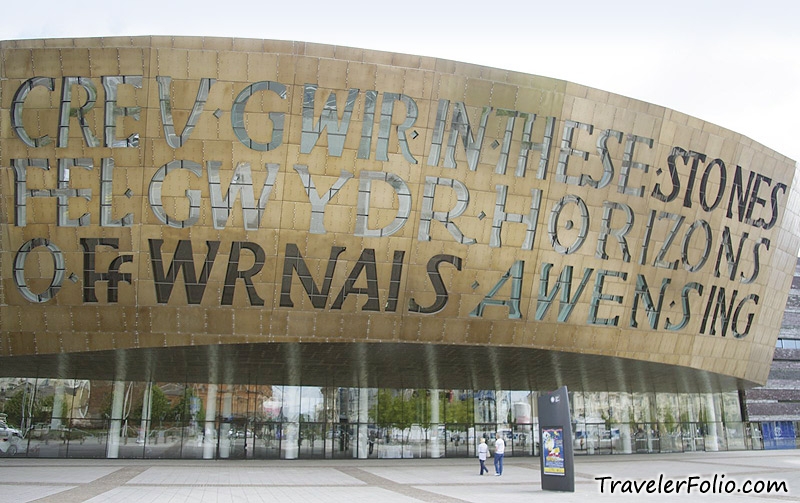
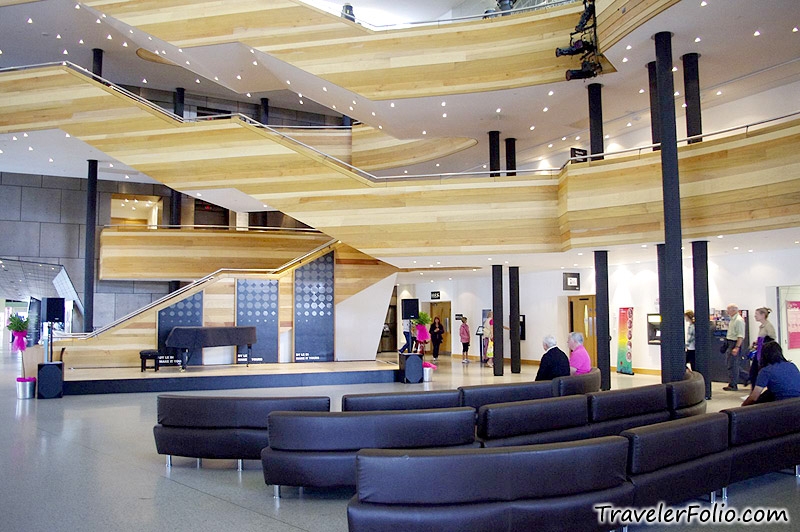
Home to the Welsh national opera and other Wales’ major cultural institutions, the Millennium Centre was opened by the Queen in 2004. Drop in for a free performance that can be jazz, classical, choir or even hip hop at the Glanfa Stage.

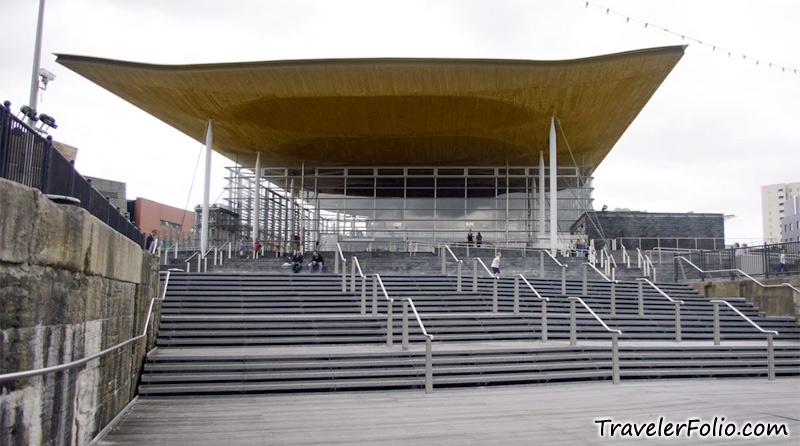
Further down, you would come across an intriguing building with a wave-like roof and see-through glass walls overlooking the bay. It’s the Welsh Senedd (Parliament) Building. Through the glass walls, everyone can see a clear view of the debating chamber and this reflects the encouragement of the involvement of public participation. The eco-friendly building incorporates natural ventilation and interestingly, when the locals express that it allows hot air to be drawn out of the debating chamber, you know it can be synonymous with heated debates!

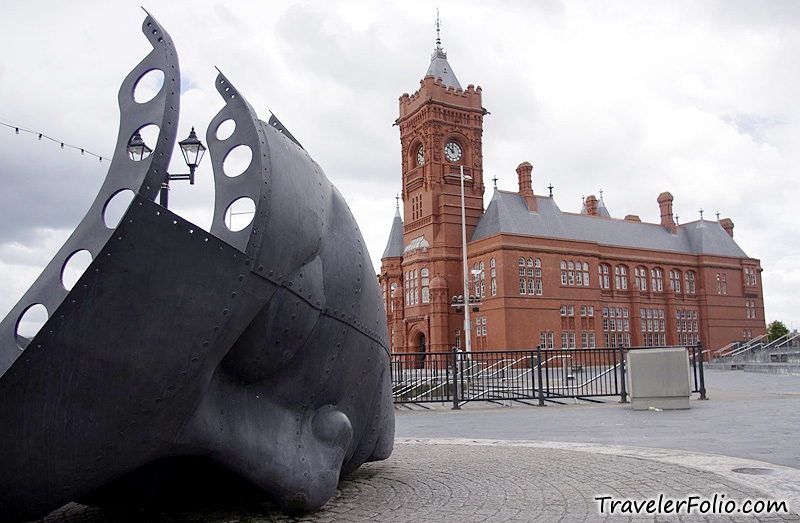
Back in the olden days, seafarers and immigrants from across the world settled near the bay and the population grew. The bustling scenes of port activities were long gone and replaced by holiday-makers relaxing around the bay. Nonetheless, the modern Cardiff Bay still retains the old charm that speaks of its glorious past as a major coal exporter to the world in the 19th century. Established in 1897, the Pierhead still stands elegantly at the waterfront. Originally the headquarters of the Cardiff Railway, the red terracotta building of French-Gothic Renaissance theme is now a Welsh history museum and exhibition centre. It’s affectionately known as the “Baby Big Ben” of Wales. In the foreground, the sculpture of a face combines with a ship hull is the Merchant Seafarers War Memorial that commemorates the seamen of Cardiff who perished during World War II.

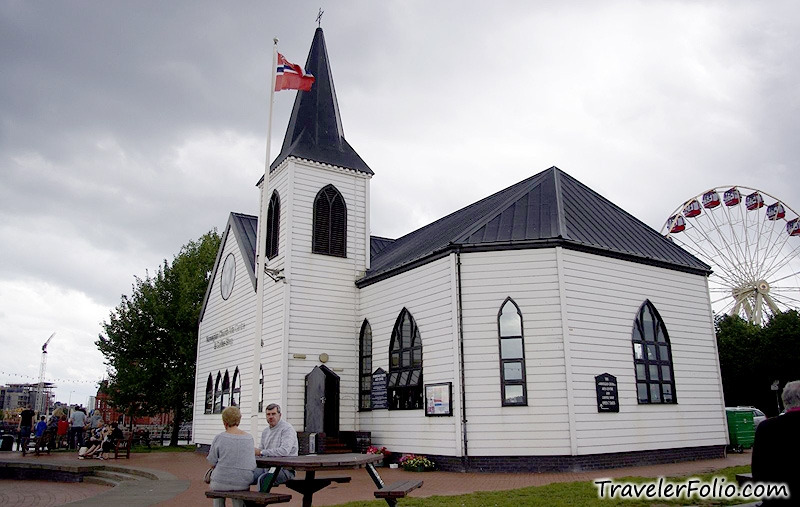
Did you know that the world famous author Roald Dahl was born in Cardiff? He was christened in the former Norwegian Sailors Church, presently known as the Norwegian Church Arts Centre that holds exhibitions, concerts and events. To try some Norwegian flavours, dine in the centre’s coffee shop that offers a range of food and drinks.

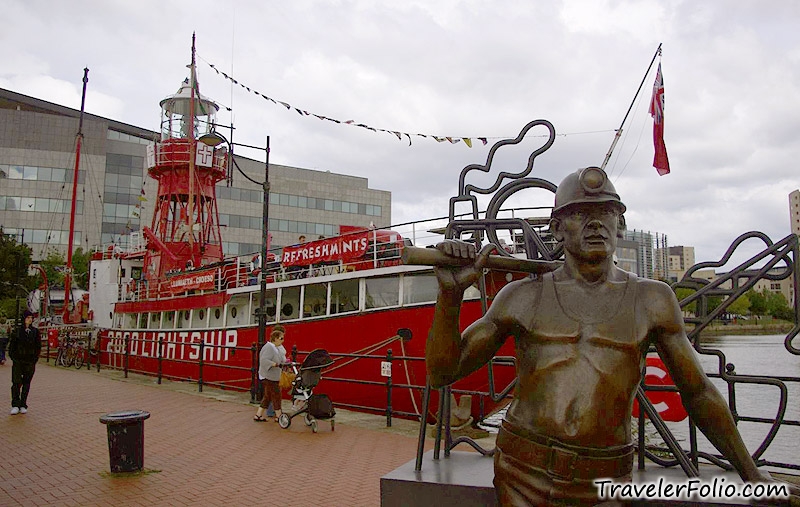
The old lightship Helwick LV14 is a floating chapel for worship and doubles as a tourist attraction where visitors can tour the vessel and enjoy refreshments with a bay view.

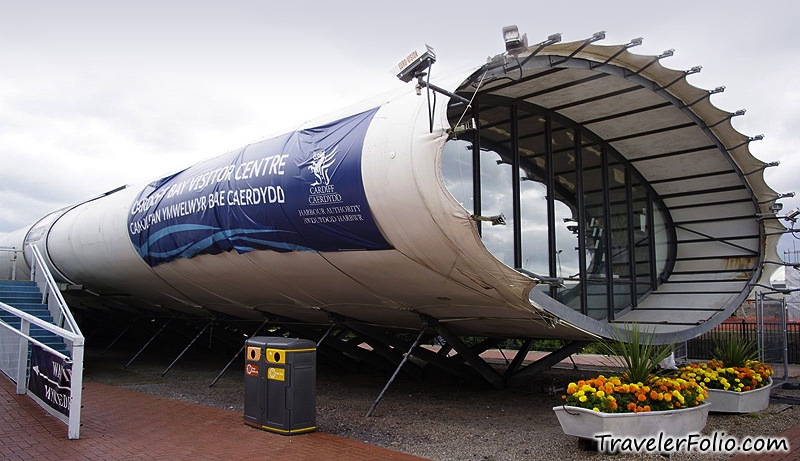
To get tourist information, souvenirs and understand more about Cardiff through videos, exhibitions and interactive displays, look for the “squashed toilet roll” structure. Locally known as “the Tube”, the design of the visitor centre is so “unconventional” that I nearly missed it!

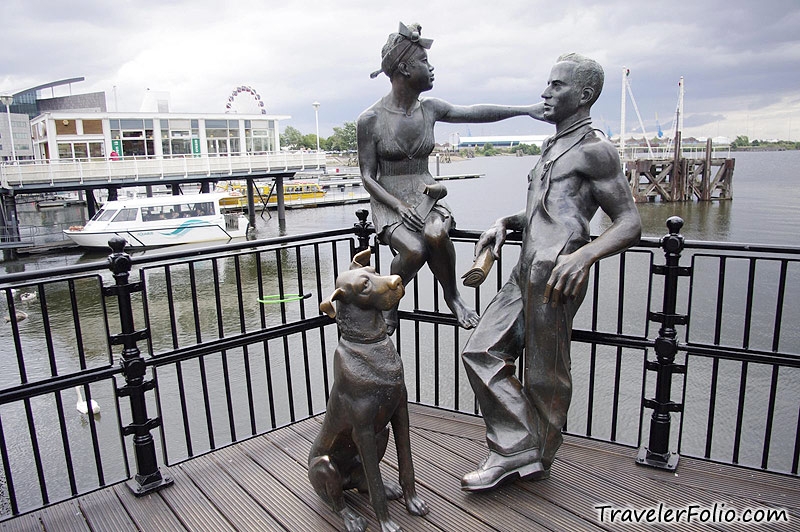
There are plenty of shops, restaurants, bars and cafes at the Mermaid Quay. Stroll along the boardwalk and greet the People Like Us. The bronze sculptures reflect the diverse culture and attributes of the world major coal exporting port in the olden days.

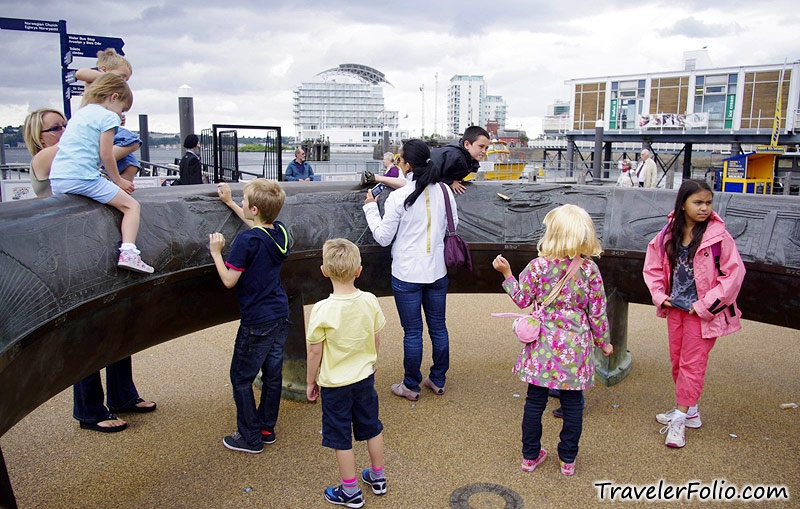
The Celtic Ring on the boardwalk with tidal charts, maritime instruments and docks indicated on its bronze surface.

If time permits, drop by Doctor Who permanent exhibition at the Red Dragon Centre in Cardiff Bay where you can find props, costumes and monsters featured in the latest series. Cardiff is home to Doctor Who, a science fiction TV series filmed in the city. Open 7 days a week till 6.30pm. An adult’s ticket costs £6.50; a child’s ticket costs £5.00.
We travelled to Cardiff Bay by the bendy bus and decided to take a different route to Cardiff Castle at the city centre by Aquabus, Cardiff’s water transport service. The designated waterbus departs hourly from Mermaid Quay to Cardiff Castle and a single adult trip costs £3 and £5 for a return trip. Kick back and enjoy the smooth sail along River Taff with a whiteness of swans swimming graciously in the waters.
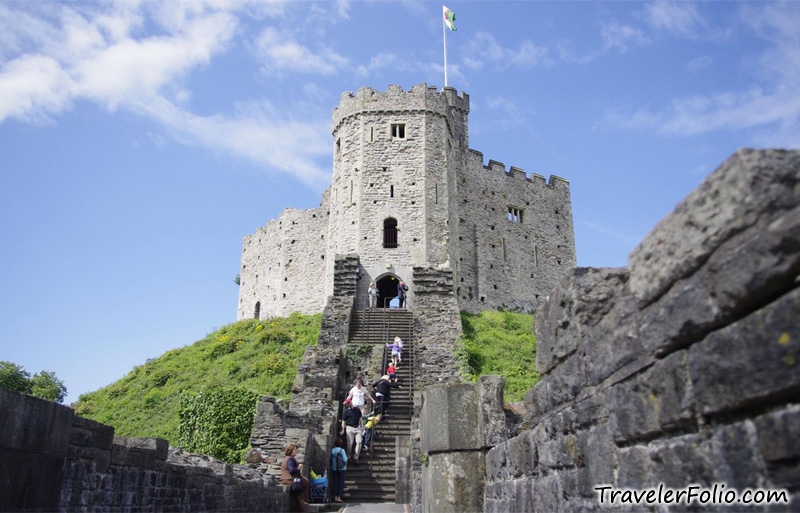
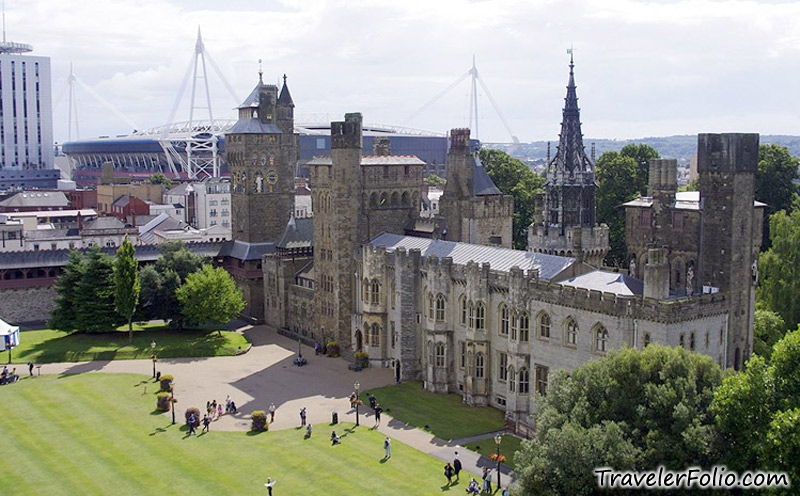
Cardiff Castle sits in the heart of the cosmopolitan city. Very deep in history, it’s the leading heritage attraction in the centre and you shouldn’t miss it. Well, you can’t miss it too! Remember I mentioned in my previous post that it’s just right across the road of Hilton Hotel where we stayed? The medieval Castle was originally constructed as a Roman fort and evolved into a variety of architectures over a period of 2000 years. It was refashioned into a neo-Gothic castle in the 19th century by the 3rd Marquess of Bute and the renowned Victorian art-architect, William Burges. In 1947, the 5th Marquess of Bute presented Cardiff Castle to the city.


Admission fee to enter the castle is £10.50 for an adult and £7.95 for a child. This includes an audio guide (with several language options) of Castle grounds, Norman Keep and Battlement walk; entry to some Castle apartments; Cardiff Castle Museum of the Welsh soldier; the Interpretation Centre with exhibition and film show.
Note: If you wish to join the 45-minute guided tour, arrive at the Castle before the tour starts at 1.40pm. The premium tour adult ticket costs £13.50 and £10.00 for a child. The premium tour will include additional Castle apartments with a guide.

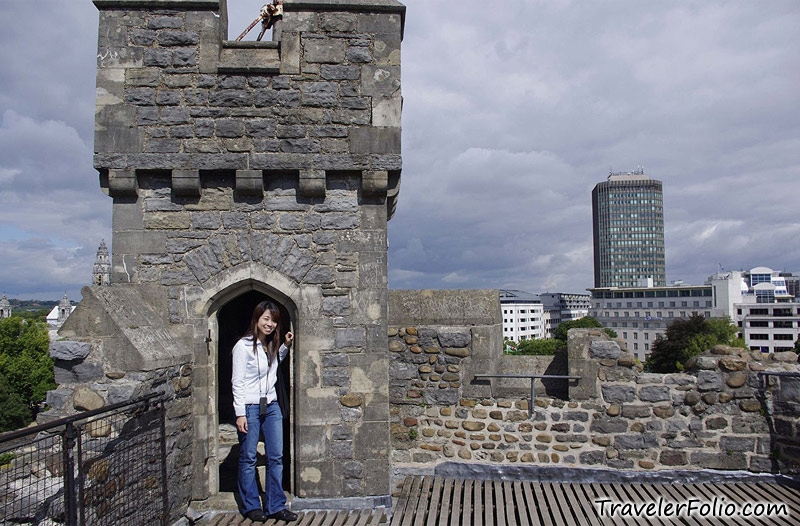
Make an easy climb up to the Norman Keep for a panoramic spectacle of the ancient Castle grounds and buildings in juxtaposition with the urbanized city. The 12th century Keep used to serve as a secure residence for the lord and his household as well as a prison and armoury. Look out for the iconic Millennium Stadium with four huge masts. Featuring a 72,000-seater capacity with a fully retractable roof, the famous sporting arena will host football competition in the London 2012 Olympics.


Adjourn to the Castle apartments to appreciate the opulent interiors and be awestruck. Highlights include the Library with a red and gold canvas adorning the walls and intricately carved furniture produced by Lord Bute’s own workshops, as well as the Arab Room with a stunning interior of Egyptian-inspired stained glass windows and Italian marble walls and floor. The medieval-themed Banqueting hall decorated with murals is the impressive centerpiece of the castle built to accommodate Lord Bute’s guests.

tourist999.blogspot.com. Powered by Blogger.